
Imagine this scenario: You get into an automotive accident, take your vehicle to the collision repair center in South Jersey, and then take your vehicle out after the repairs for a road test. Everything seems to be functioning as it should. The brakes work. The steering wheel rotates without any issue. Then later, you notice something off. That is because a vehicle can pass a road test but still have hidden collision damage.
Road tests, after all, do not determine the quality of the collision repair or even address many issues that may be left after repairs. Many issues can go undetected, such as hidden structural damage, suspension problems, improperly repaired mounting points, and driver-assistance systems.
Key Takeaways
- A successful road test does not guarantee that all collision damage has been identified or properly repaired.
- Hidden structural damage may affect frame components, mounting points, and areas behind exterior panels without causing immediate driving symptoms.
- Collision-related suspension and alignment problems can lead to handling issues, uneven tire wear, and additional damage over time.
- Modern safety systems, including ADAS sensors, cameras, and airbag systems, may require specialized diagnostics, inspections, or manufacturer-specified procedures after a collision.
- A thorough post-collision evaluation combines road testing with structural assessments, mechanical inspections, and electronic diagnostics when appropriate.
What a Road Test Can—and Cannot—Reveal
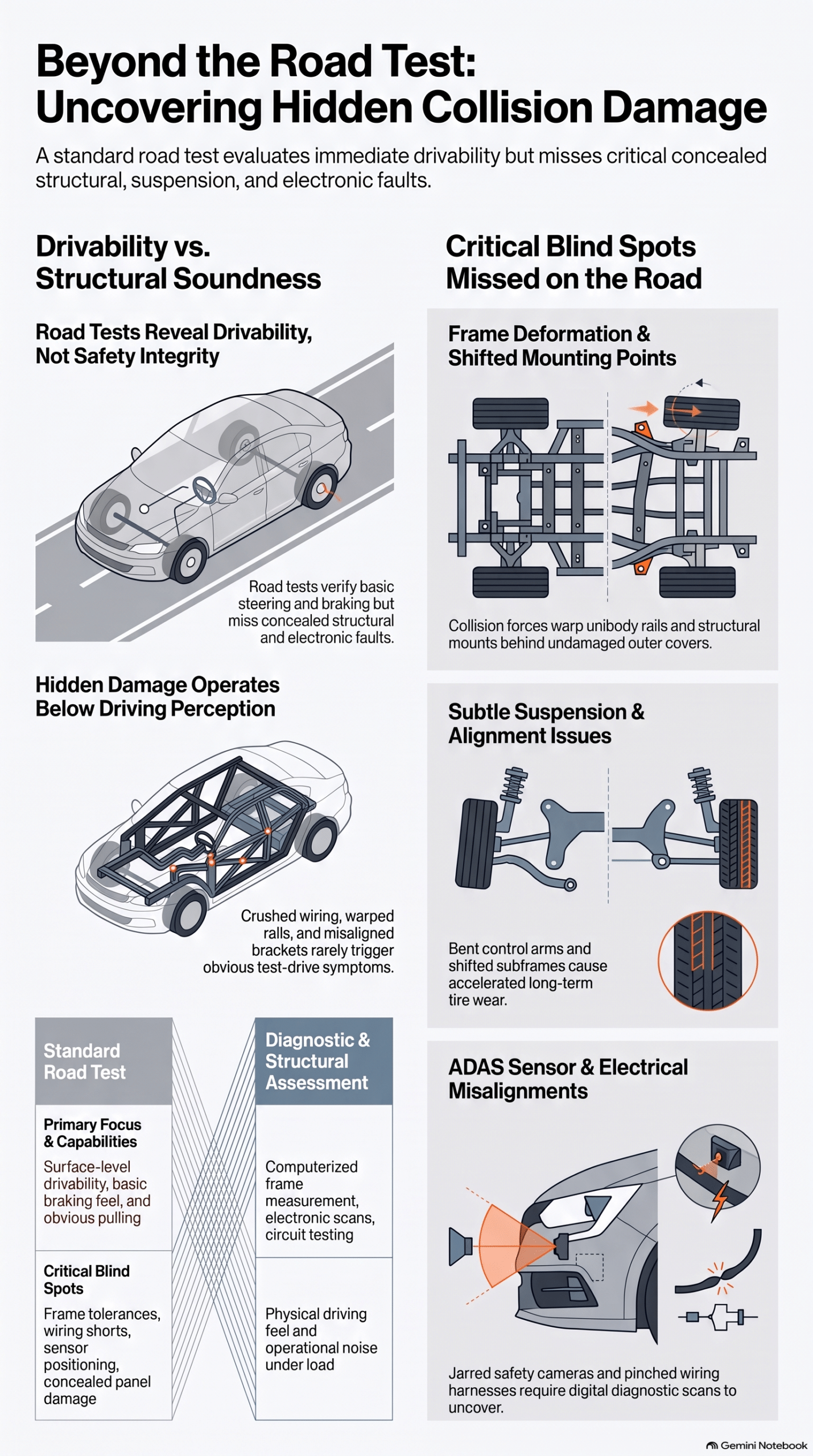
A road test evaluates a vehicle’s drivability, but drivability and soundness are not the same thing. Road tests help verify specific issues that may impact performance, including:
- Pulling to one side or difficulty maintaining a straight path.
- Steering wheel vibration, unusual noises, or changes in steering response.
- Braking issues, including abnormal pedal feel or vibration.
- Warning lights on the dashboard.
- Shifting issues or other problems that appear when driving.
- Vehicle instability.
- Noticeable issues with driver-assistance features.
However, road tests do not find many issues that do not impact driving performance directly. This may include:
- Damage behind bumpers, body panels, or interior trim.
- Structural measurements that fall outside manufacturer specifications.
- Cracked, bent, or improperly repaired components that do not produce symptoms during the road test.
- Faults in airbags, sensors, wiring, or other electronic systems that require diagnostics, not a road test, to identify.
- Whether OEM parts were used and manufacturer guidelines were followed.
Hidden Structural Damage May Not Affect Everyday Driving Immediately
During a collision, forces are transferred through the vehicle far beyond the point of impact, especially when the collision happened at higher speeds. A dented bumper, for example, shows damage at the point of impact but may not be the extent of it. Forces may have caused structural damage beyond the panels that will alter performance and safety if the issue goes without repair.
Hidden structural damage may occur in the following places:
- Unibody and frame components: Depending on the vehicle’s construction and the severity of the impact, the force of the impact can affect structural rails, reinforcement components, pillars, and other structural areas.
- Mounting points: Damage to the suspension, steering, and component mounting points may affect how replacement parts fit or function after a collision.
- Deformation behind exterior panels: Body panels, bumper covers, absorbers, and other components may carry hidden damage.
- Repair tolerances: Structural components may need to be measured against manufacturer specifications. A vehicle can feel normal but the measurements may not be within the correct specifications.
Suspension and Alignment Problems Can Be Subtle
As mentioned previously, impact forces can move through a vehicle, causing damage that is deeper than it may initially appear. Suspension and alignment are two places where a vehicle can be subtly damaged after even a minor incident. Unfortunately, these issues will worsen over time.
The following problems may not be obvious during a road test but will still affect how a vehicle handles:
- Bent control arms, tie rods, or other suspension and steering components.
- Damaged wheel bearings, wheels, and other related components.
- Shifted or damaged suspension mounting points.
- Alignment angles outside of manufacturer specifications.
- Uneven tire wear, steering vibration, or handling changes.
During a short road test, these issues may not manifest in a way that is immediately noticeable. A bent control arm, for example, may not be perceptible until you reach a certain speed and go over a bump.
However, given enough time to worsen, these problems can alter how your vehicle functions, leading to more widespread damage.
Modern Safety Systems Can Have Problems Without Noticeable Driving Symptoms
In the past, vehicles had fewer electronic components inside of them. Modern vehicles are fitted with ADAS sensors and cameras, which are located throughout the vehicle, often behind the very panels that can be affected during a collision. An impact, for instance, may jar cameras, throwing off their alignment.
The following systems are often affected by collisions and will require recalibration after collision repair to ensure full functionality:
- Advanced Driver-Assistance Systems (ADAS): Automatic emergency braking, lane departure warnings, and adaptive cruise control rely on cameras, radar, and other sensors. If any component is misaligned, the system may malfunction.
- Sensor and camera-positioning: A collision may damage brackets, changing the position of a camera or sensor even when the component remains intact and functional.
- Diagnostic trouble codes: Some faults can only be detected with the use of diagnostic systems.
- Airbag and restraint systems: These systems must be restored and recalibrated following specific instructions.
As such, even if accident damage appears non-existent, it’s important to bring your vehicle to a collision repair center for an inspection. Sometimes the hidden damage may be a crucial part of a safety system that will only register with a diagnostic scan.
Some Collision-Related Problems Only Become Noticeable Later
There are many issues that may not be noticeable during the initial road test because it takes time to develop. One example is uneven tire wear. Alignment issues may not result in any noticeable pulling or tire wear after repairs, but they do worsen with more driving. Intermittent electrical problems caused by a broken bracket or unaligned sensor can be fine for days then occur during a particularly humid one.
Any recurring symptoms after a collision deserve attention. Do not dismiss a worry merely due to your vehicle passing an earlier road test.
Warning Signs That Should Not Be Ignored
Here is a list of signs that warrant a follow-up with a collision repair center in South Jersey like Elmer’s Auto Body:
- Your vehicle pulls to one side of the road, or the steering wheel feels off-center.
- New vibrations, grinding, clunking, or unusual sounds develop.
- Tires develop uneven wear and tear.
- Warning lights appear or safety features behave differently than expected.
- Doors, the truck, or hood do not align or close normally.
- There is unexplained rattling or wind noise that wasn’t there before.
- The vehicle’s handling or braking is not the same as it was before the accident.
Why Repair Quality Matters More Than a Single Test
Even if your car feels normal post-repair, a road test does not immediately mean that everything is fine. Road tests are valuable, but they may not reveal certain problems while driving. It is but one facet of a comprehensive collision repair process. What is more important than a road is a proper structural assessment, mechanical inspection, and electronics diagnosis, particularly for newer models.
The more in-depth the inspection before and after repairs, the greater the chance of hidden damage being located and fixed before it can grow worse. This is also why it is important to choose a reputable collision repair shop that follows manufacturer guidelines.
Frequently Asked Questions
Can a car pass a road test and still have hidden collision damage?
Yes. A road test evaluates how a vehicle performs under specific driving conditions, but it cannot identify every type of collision damage. Structural deformation, damaged mounting points, electronic faults, and problems concealed behind body panels may require specialized inspections or diagnostic equipment.
What types of collision damage can a road test miss?
A road test may not reveal hidden structural damage, bent suspension components, damaged wiring, improperly positioned sensors, or repairs that do not meet manufacturer specifications. Some issues produce no obvious symptoms during a short drive and require additional testing to identify.
How can I tell if my vehicle has hidden damage after an accident?
Warning signs may include pulling to one side, an off-center steering wheel, unusual noises or vibrations, uneven tire wear, warning lights, or changes in braking and handling. However, some damage causes no noticeable symptoms. A professional collision inspection can help identify problems that are not visible to the driver.
Does a collision affect a vehicle’s safety sensors and driver-assistance systems?
It can. A collision may damage sensors, cameras, mounting brackets, or related wiring, potentially affecting systems such as lane departure warnings, adaptive cruise control, and automatic emergency braking. Depending on the damage and vehicle manufacturer’s procedures, inspections, diagnostic scans, or ADAS calibration may be necessary.
What should I do if I notice problems after collision repairs?
Contact your collision repair facility and describe the symptoms so the vehicle can be evaluated. New steering problems, unusual noises, warning lights, or changes in braking and handling should not be ignored. If you suspect a critical safety problem, stop driving when it is safe to do so and arrange professional assistance.
Why is a professional collision inspection important?
A professional inspection can identify damage that a road test or visual check alone may miss. Depending on the vehicle and the collision, the process may include structural measurements, suspension and steering inspections, electronic diagnostics, and manufacturer-required safety system procedures. These checks help ensure that necessary repairs are identified and addressed.
Final Thoughts: Elmer’s Auto Body Finds Hidden Structural Damage the First Time
While a vehicle can pass a road test, that doesn’t mean that every bit of hidden damage has been found or repaired. Diagnostic testing and thorough inspections are required. If you have recently experienced an auto collision in South Jersey, don’t wait to seek a professional evaluation for your vehicle. The sooner damage is found, the sooner your vehicle can be restored to its pre-accident condition.
Auto Body Repair in South Jersey Done Right Since 1947
At Elmer’s Auto Body, you don’t have to wonder if you’re driving away with hidden structural damage. Our auto body repair technicians have many years of experience and use manufacturer-approved techniques and tools to find hard-to-find damage. Give us a call at one of our three convenient locations:
Mt. Ephraim: (856) 456-7018 |
Sewell: (856) 218-0202 |
Medford: (609) 714-4050